Checks python3 and curl, verifies the shebang and the SHA256, installs
in ~/.local/bin/sysinfo, and prints the $PATH line to add if needed.
02 — Manual
mkdir -p ~/.local/bin
cp sysinfo.py ~/.local/bin/sysinfo
chmod +x ~/.local/bin/sysinfo
export PATH="$HOME/.local/bin:$PATH"   # si pas déjà dans le PATH
Verifiable checksum:
curl -sSL https://devexploris.com/sysinfo/sysinfo.py -o sysinfo.py
curl -sSL https://devexploris.com/sysinfo/sysinfo.py.sha256 -o sysinfo.py.sha256
sha256sum -c sysinfo.py.sha256   # shasum -a 256 sur macOS
03 — Commands
Available flags
Flags compose: each one adds its block to the output. -a turns them all on.
01 — System
Flag
Output
-a, --all
Every block available
-4, --ipv4
IPv4 address of the outbound network interface
-g, --groups
Groups the current user belongs to
-u, --uptime
Machine uptime, read from /proc/uptime. Linux only
02 — Network
Flag
Output
-l, --location
Public IP + city/country via ipinfo.io, fallback ip-api.com
--local-ip
LAN address, without external call
--vpn
VPN / proxy / hosting detection (heuristic, see limitations)
--ports
Listening ports via ss, falling back to netstat
03 — SSH · Docker
Flag
Output
--ssh
Hosts declared in ~/.ssh/config, with user and hostname
--docker
Running containers and Docker networks, via the docker CLI
Combining:
sysinfo -l --vpn          # localisation + détection VPN
sysinfo --local-ip -4     # IP locale et IPv4 réseau
sysinfo -a -t             # tout, sous forme de tableau
sysinfo --ssh --docker    # hosts SSH et containers
04 — Output modes
In lines, or in a table
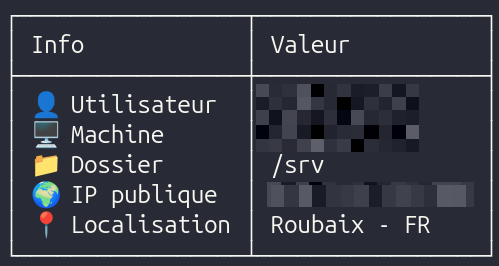
By default, one line per info. -t renders the same data as a two-column table,
fitted to the terminal width. -c adds color, -i opens the interactive mode.
(default)
One line per info
-t, --table
Two-column table
-c, --color
ANSI colors
-i, --interactive
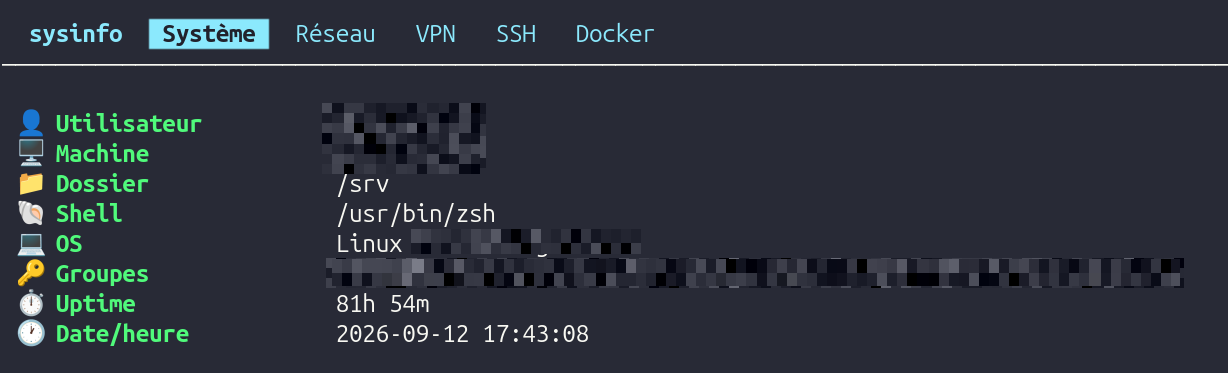
Navigable tabs, see below
-h, --help
Flags and examples
sysinfo -l -t05 — Interactive mode
Five navigable tabs
$sysinfo -i
Built with curses. Each tab caches its result in memory;
r forces a fresh fetch.
sysinfo -i
Keyboard
Key
Action
← → · Tab
Switch tab
r
Refresh the current tab (invalidates its cache)
q · Échap
Quit
06 — Security
Checksum and permissions
The script is published with its SHA256: install.sh and --update check
it, and it can be checked by hand. The script does not call sudo.
sha256sum -c sysinfo.py.sha256 # shasum -a 256 sur macOS
Permissions
Feature
Without sudo
With sudo
System · network · SSH
Full output
No difference
--ports
Other users' processes shown as N/A
All processes visible
--docker
Error message if not in the docker group
Works
--update
Suggests sudo if installed in a system directory
Works
07 — Update
What --update does
$sysinfo --update ✓ Checksum vérifié ✓ sysinfo mis à jour
01
Download
02
SHA256
03
Compare
04
os.replace()
01
The remote script is downloaded to a temporary file.
02
Its SHA256 is verified against the published checksum. If they differ, nothing is written.
03
The remote checksum is compared to the installed file's. If they match, the script is already up to date.
04
os.replace() swaps the file atomically: an interrupted update leaves no half-written script.
Install path:
resolved via shutil.which() when the script is launched through the
$PATH, so --update works from any install directory.
08 — Limitations
External API and uptime
--vpn
Relies on an external API call: a rate limit can be reached.